
Amazon Redshift Incremental Snapshot Billing
Organizations increasingly rely on Amazon Redshift snapshots to protect business-critical analytics workloads. Amazon Redshift snapshots help organizations protect critical analytics data through reliable point-in-time backups, ensuring business continuity, compliance readiness, and disaster recovery preparedness.
Beginning in June 2026, Amazon Redshift enhanced its pricing model for Serverless and Redshift RG deployments by introducing incremental snapshot billing, which reduces storage costs by charging only for unique snapshot data blocks.This enhancement fundamentally changes how customers pay for snapshot storage by charging only for unique data blocks across active manual snapshots rather than the cumulative size of every snapshot.
The result is a smarter, more cost-efficient backup strategy that allows organizations to improve Recovery Point Objectives (RPO), extend retention policies, and strengthen disaster recovery without significantly increasing storage costs.
In this article, we explore how incremental snapshot billing works, provide practical examples, and demonstrate how Trucost.Cloud can further optimize Amazon Redshift costs through intelligent recommendations and automated cost governance.
Understanding Incremental Snapshot Billing
Traditional backup models often create concerns around storage growth because every retained snapshot appears to increase backup costs. However, in reality, most enterprise data warehouses experience relatively small daily changes compared to their overall size.
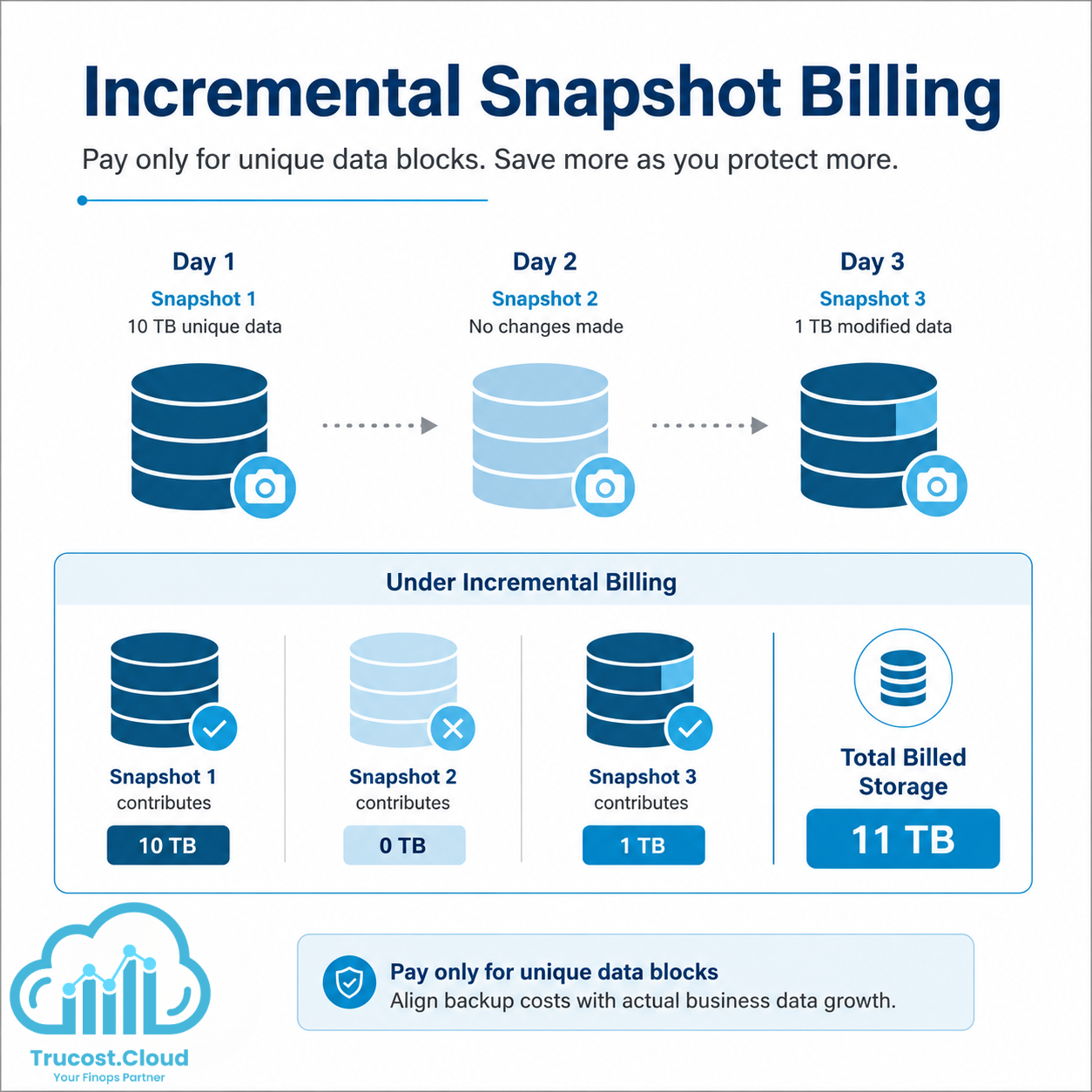
With incremental snapshot billing, Amazon Redshift identifies duplicate data blocks across snapshots and bills only for unique blocks.
Consider a 10 TB Amazon Redshift Serverless data warehouse:
- Day 1 Snapshot: 10 TB unique data
- Day 2 Snapshot: No changes made
- Day 3 Snapshot: Contains 1 TB of new unique data generated since the previous snapshot.
Under incremental billing:
- Snapshot 1 contributes 10 TB
- Snapshot 2 contributes 0 TB
- Snapshot 3 contributes 1 TB
Total billed storage = 11 TB
Instead of paying for the cumulative size of multiple snapshots, customers are now charged only for unique data blocks across active snapshots.
This approach aligns backup costs more closely with actual business data growth.
Example: Financial Services Organization
A banking institution operates a 20 TB Amazon Redshift RG cluster for risk analytics and compliance reporting.
Requirements:
- Daily snapshots
- 90-day retention
- Cross-Region disaster recovery
- Regulatory compliance mandates
Average daily change rate: 3%
Daily change volume:
20 TB × 3% = 0.6 TB
After 90 days:
Unique storage required:
20 TB + (89 × 0.6 TB)
= 73.4 TB
Without block-level deduplication, the cumulative size of 90 retained snapshots could approach:
20 TB × 90 = 1,800 TB
Incremental snapshot billing significantly reduces the amount of billable snapshot storage by charging only for unique data blocks.
The organization gains:
- Extended retention
- Improved audit readiness
- Lower backup storage spend
- Better disaster recovery coverage
Better Recovery Point Objectives (RPO)
Many organizations historically limited the frequency of snapshot creation due to the increasing costs associated with storing multiple backups.
With incremental snapshot billing, only newly changed data blocks contribute to additional storage charges.
Example:
10 TB warehouse
Daily change rate = 5%
Approximately 0.2% per hour assuming a 5% daily change rate.
Each hourly snapshot contributes only a fraction of the overall dataset.
Benefits include:
- More recovery points
- Reduced data loss exposure
- Faster business recovery
- Stronger business continuity planning
Organizations can now move from daily snapshots to hourly snapshots with significantly lower incremental costs.
Cross-Region Disaster Recovery Becomes More Affordable
Disaster recovery architectures often require snapshot replication across AWS Regions.
Previously, organizations hesitated to increase replication frequency due to storage concerns.
With incremental billing:
- Snapshot copies across Regions are billed based on unique data blocks, helping keep disaster recovery storage costs proportional to actual data changes.
- Storage growth remains proportional to actual changes
- DR environments become more economical
For example:
A retail company operating in US-East and US-West can replicate snapshots more frequently while benefiting from billing that is based on unique data blocks rather than the cumulative size of full snapshot copies.
This improves:
- Recovery Point Objectives
- Geographic resilience
- Compliance readiness
Sample Cost Calculation
Assume:
Amazon Redshift Serverless
Active Data: 10 TB
Retention: 7 Daily Snapshots
Daily Change Rate: 5%
Snapshot storage growth:
10 TB + (6 × 0.5 TB)
= 13 TB
Assuming snapshot pricing of $0.023/GB:
Active Storage:
10 × 1,024 × $0.023
= $235.52/month
Snapshot Storage:
13 × 1,024 × $0.023
= $306.18/month
Total Monthly Cost:
$541.70
Instead of paying for the cumulative size of all seven snapshots, customers pay only for 13 TB of unique data.
Additional Savings with Amazon Redshift RG
Organizations evaluating migration from RA3 to RG can unlock multiple layers of savings.
Key advantages include:
Compute Savings
RG clusters offer approximately 30% lower pricing compared to equivalent RA3 deployments.
Reserved Instance Eligibility
Customers can combine RG with Reserved Instances for predictable long-term savings.
Snapshot Optimization
Incremental billing eliminates duplicate snapshot storage charges.
Spectrum Cost Reduction
Data lake queries are included in RG compute pricing, reducing separate scanning charges associated with Amazon Redshift Spectrum workloads.
Combined savings often exceed 30% when organizations optimize compute, storage, and backup strategies together.
Who Benefits Most from Incremental Snapshot Billing?
While all Amazon Redshift Serverless and Amazon Redshift RG customers benefit from lower snapshot storage costs, the greatest value is realized by organizations with stringent backup, compliance, and disaster recovery requirements.
Financial Services
Banks, insurance providers, and investment firms often require long-term backup retention and frequent recovery points to meet regulatory obligations and business continuity requirements.
Healthcare and Life Sciences
Healthcare organizations must retain data for extended periods while maintaining compliance with industry regulations. With incremental snapshot billing, organizations can retain snapshots for extended periods while keeping storage costs under control.
Government and Public Sector
Government agencies frequently require multi-year data retention policies and cross-Region disaster recovery strategies. Reduced snapshot storage costs help support these requirements within budget constraints.
SaaS Platforms
Software providers managing large volumes of customer data can increase snapshot frequency and strengthen disaster recovery readiness without proportionally increasing storage costs.
Data Analytics and Business Intelligence Teams
Organizations running large-scale analytics workloads on Amazon Redshift can retain more historical recovery points and support audit requirements while controlling storage growth.
Multi-Region Enterprises
Companies operating across multiple AWS Regions can replicate snapshots more frequently and improve resilience while keeping disaster recovery costs aligned with actual data changes.
How Trucost.Cloud Enhances Amazon Redshift Cost Optimization
While Amazon Redshift’s new billing model reduces snapshot costs automatically, organizations still need visibility into how storage growth, retention policies, and cluster utilization impact overall spending.
This is where Trucost.Cloud provides additional value.
The following examples illustrate the types of insights and recommendations Trucost.Cloud can provide based on observed usage patterns and cost analysis.
Snapshot Cost Intelligence
Trucost.Cloud continuously analyzes:
- Snapshot growth trends
- Retention policy effectiveness
- Unique block accumulation
- Cross-Region backup costs
Example Recommendation:
“Your Amazon Redshift Serverless workgroup currently retains snapshots for 365 days, while compliance requirements mandate a retention period of only 180 days. Reducing retention can save approximately $4,800 annually.”
Rightsizing Recommendations
Many Redshift environments are overprovisioned.
Trucost.Cloud identifies:
- Underutilized clusters
- Low utilization workgroups
- Idle compute resources
Example Recommendation:
“Cluster utilization averages 28% during business hours. Migrating to Redshift Serverless could reduce annual compute costs by 35%.”
RA3 to RG Migration Assessment
Trucost.Cloud can evaluate:
- Compute consumption
- Storage utilization
- Query patterns
- Reserved Instance opportunities
Example Recommendation:
“Analysis indicates that migrating from RA3.16xlarge to Amazon Redshift RG and leveraging a 1-year Reserved Instance could potentially reduce annual infrastructure costs by approximately $72,000.”
Cross-Region DR Optimization
Trucost.Cloud analyzes:
- Snapshot copy frequency
- Data change rates
- Regional storage costs
Example Recommendation:
“An assessment of the current disaster recovery strategy indicates that replicating data every 15 minutes may provide limited additional benefit compared to an hourly replication schedule. Adjusting policy could reduce DR costs by 18% while maintaining business RPO targets.”
Compliance Cost Forecasting
For regulated industries, Trucost.Cloud forecasts future storage growth based on:
- Historical change rates
- Retention requirements
- Snapshot frequency
This helps finance and cloud teams accurately budget future backup costs.
Getting Started
Customers automatically benefit from Amazon Redshift’s incremental snapshot billing without making any configuration changes.
To maximize savings:
1. Review snapshot retention policies.
2. Increase snapshot frequency where tighter RPOs are required.
3. Evaluate migration from RA3 to RG.
4. Explore Amazon Redshift Serverless for variable workloads.
5. Use Trucost.Cloud recommendations to continuously identify storage, compute, and disaster recovery optimization opportunities.
Conclusion
Amazon Redshift’s incremental snapshot billing model represents a significant advancement in cloud data warehouse cost optimization. By charging only for unique data blocks, organizations can maintain more snapshots, extend retention periods, and improve disaster recovery readiness without proportional increases in storage costs.
When combined with Amazon Redshift RG pricing advantages and intelligent cost governance from Trucost.Cloud, organizations can build a modern analytics platform that balances performance, resilience, compliance, and cost efficiency.
The combination of incremental snapshot billing and Trucost.Cloud’s recommendation engine empowers businesses to move beyond reactive cost management and adopt a proactive FinOps strategy—ensuring every terabyte stored and every snapshot retained delivers measurable business value.
Frequently Asked Questions (FAQs)
1. What is Amazon Redshift incremental snapshot billing?
Incremental snapshot billing is a pricing model where Amazon Redshift charges only for unique data blocks across active manual snapshots, instead of charging for the full size of each snapshot. This reduces storage costs when multiple snapshots share unchanged data.
2. Which Amazon Redshift offerings support this billing model?
This model applies to:
- Amazon Redshift Serverless
- Amazon Redshift RG (Graviton-based provisioned clusters)
It does not apply to RA3 clusters, which continue using the existing snapshot billing model.
3. Do automated snapshots also use incremental billing?
No. Automated snapshots remain unchanged:
- Free within retention window
- Serverless: 24 hours
- Provisioned: up to 35 days
Incremental billing applies only to manual snapshots.
4. How does this improve disaster recovery (DR)?
Because snapshots are billed only on changed data, organizations can:
- Take more frequent snapshots (hourly instead of daily)
- Improve Recovery Point Objective (RPO)
- Reduce potential data loss during failures
- Replicate snapshots across Regions more cost-efficiently
5. Do I need to change anything to enable incremental snapshot billing?
No action is required.
Existing manual snapshots will automatically transition to the new billing model starting June 2026, and all future snapshots will be billed based on unique data blocks.