
3 Signs Your Org Needs FinOps — Not Just an AWS Bill Review
Cloud costs rarely become a problem overnight.
More often, it starts with a familiar scenario: the monthly AWS invoice arrives, and it’s much higher than expected. Finance asks what changed. Engineering scrambles to investigate. A few oversized instances get resized, some unused resources are deleted, and everyone agrees to “optimize cloud costs.”
For a few weeks, everything looks better.
Then the next unexpected bill arrives, and the cycle begins again.
If this sounds familiar, your organization probably doesn’t have an AWS billing problem—it has a cloud cost management problem.
A one-time AWS bill review can identify waste that already exists. But it can’t prevent new waste from being created tomorrow. That’s because cloud spending isn’t a monthly event—it’s the cumulative result of hundreds of engineering decisions made every day.
This is where FinOps changes the conversation.
Rather than treating cloud cost optimization as a quarterly cleanup exercise, FinOps makes cost awareness a continuous part of how engineering, finance, and business teams operate together.
Here are three signs your organization is ready to move beyond AWS bill reviews and adopt FinOps.
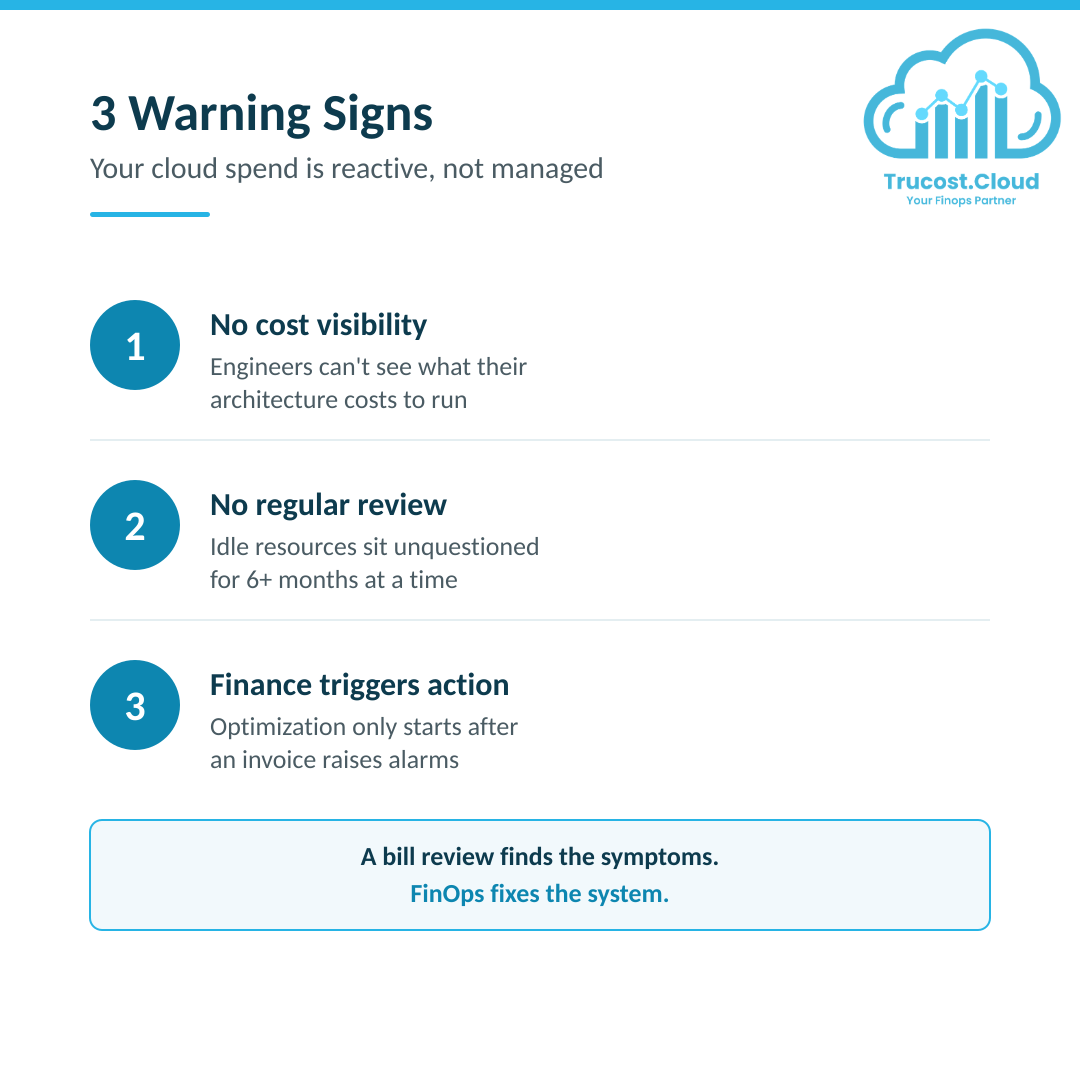
Sign #1: Engineers Can’t Tell You What Their Services Cost
Ask an engineer a simple question:
“How much does your application cost to run every month?”
If the answer is “I’m not sure,” that’s not an individual knowledge gap—it’s an organizational one.
Every architectural decision has a financial impact:
- Choosing between managed and self-managed services
- Selecting instance sizes
- Running Kubernetes clusters versus serverless workloads
- Retaining logs for 30 days versus one year
- Keeping development environments running 24/7
Most engineers optimize for what they can see:
- Performance
- Reliability
- Scalability
- Developer productivity
Cost often isn’t visible until weeks later in a billing dashboard that engineering rarely checks.
By then, the decision has already become part of production.
Why this matters
When engineers can see the financial impact of their architectural choices before deployment, cost becomes another engineering metric—just like latency, availability, or performance.
That’s proactive optimization instead of reactive cost cutting.
Sign #2: Nobody Regularly Asks, “Do We Still Need This?”
Cloud waste rarely looks dramatic.
Instead, it quietly accumulates over time.
Examples include:
- Idle load balancers
- Orphaned EBS volumes
- Overprovisioned RDS databases
- Forgotten development environments
- Unattached Elastic IPs
- Snapshots that nobody remembers creating
- Test infrastructure that’s been running for months
Individually, these resources might cost only a few dollars per day.
Collectively, they can add up to thousands—or even hundreds of thousands—of dollars annually.
The challenge is that these costs become part of the baseline.
And baselines tend to grow without being questioned.
Organizations that rely solely on quarterly or annual reviews often discover waste months after it begins.
By then, dozens of teams may have created similar inefficiencies.
Why this matters
Effective FinOps creates a regular operating rhythm.
Instead of asking once a quarter,
“What can we delete?”
teams continuously ask,
“Does this resource still deliver business value?”
That simple shift prevents waste from becoming permanent.
Sign #3: Cost Optimization Only Starts When Finance Raises an Alarm
If cloud cost discussions only happen after Finance notices a large invoice, your organization is operating reactively.
This usually follows a predictable pattern:
- Cloud spend increases
- Finance escalates
- Engineering investigates
- Teams rush to optimize
- Costs decrease temporarily
- Growth resumes
- The cycle repeats
The problem isn’t necessarily high cloud spending.
Sometimes higher cloud costs are exactly what the business wants—especially when they’re supporting customer growth or increased revenue.
The real issue is that no one owns cloud spending before it happens.
Finance owns budgets.
Engineering owns infrastructure.
Product owns delivery.
Leadership owns business outcomes.
Without shared accountability, cloud spending becomes everyone’s responsibility only after the invoice arrives.
Why this matters
Organizations with mature FinOps practices don’t wait for month-end surprises.
Cloud cost becomes part of everyday planning, architecture reviews, deployment pipelines, and product decisions.
AWS Bill Review vs FinOps: What’s the Difference?
An AWS bill review is valuable.
It can identify:
- Idle resources
- Misconfigured services
- Reserved Instance opportunities
- Storage inefficiencies
- Immediate cost-saving opportunities
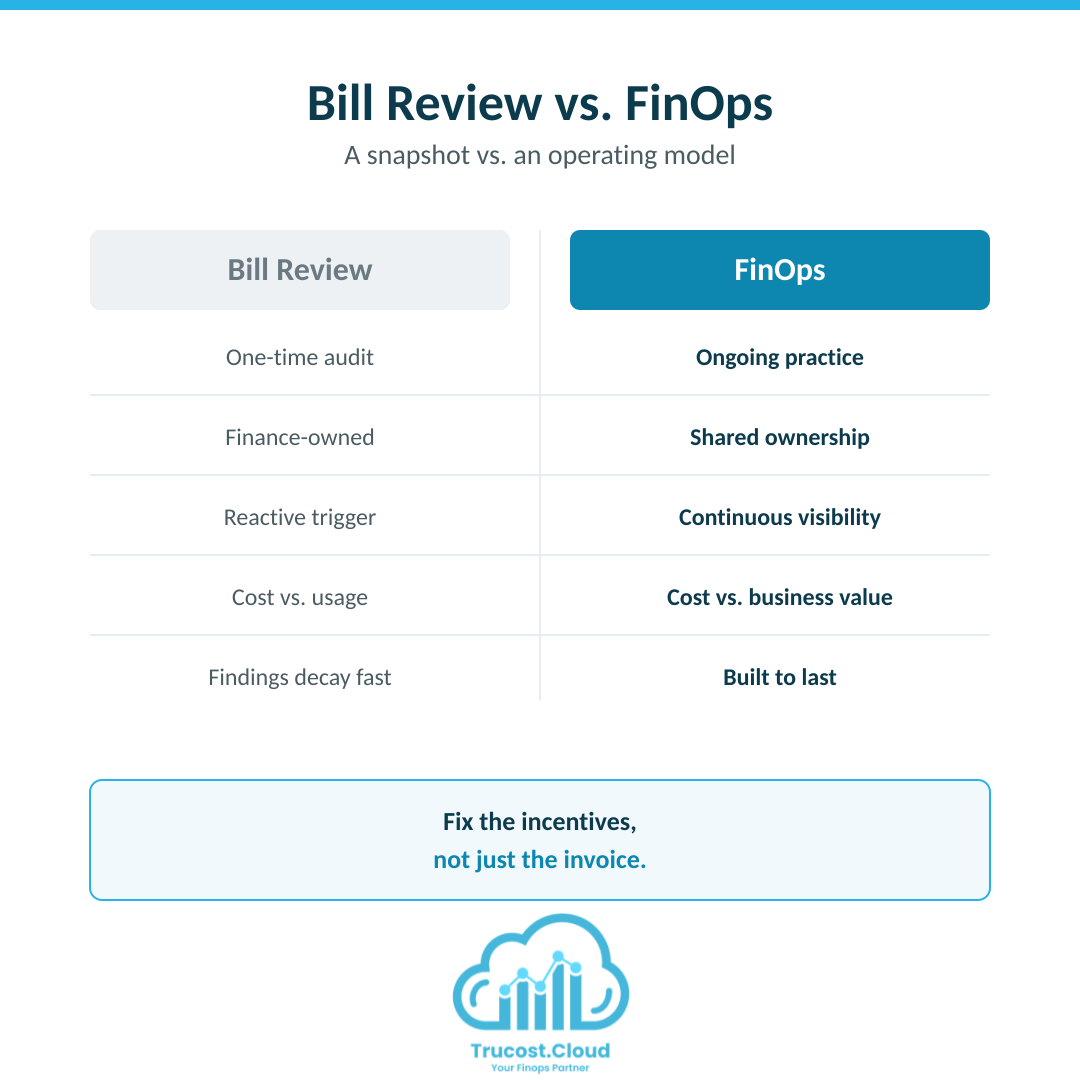
But it’s still a snapshot.
The moment the report is delivered, new workloads are deployed, new resources are provisioned, and new costs begin accumulating.
The recommendations gradually become outdated.
Common Mistakes Organizations Make During AWS Bill Reviews
- Running the review once and calling it done, rather than building it into a regular rhythm
- Fixing symptoms without asking why resources were misconfigured
- Excluding engineering from the review process
- Chasing savings percentages instead of cost-per-value
- No clear owner for implementing recommendations
- Optimizing costs before fixing tagging and allocation visibility
FinOps is fundamentally different.
It’s an operating model that creates shared accountability between engineering, finance, and leadership.
Instead of asking:
“Where did we waste money last month?”
FinOps asks:
- How can engineers understand cost before making deployment decisions?
- Which workloads create the most business value?
- How do we make cloud spending visible across teams?
- How can we prevent waste instead of continuously cleaning it up?
The difference isn’t better reporting.
It’s building cost awareness into everyday decision-making.
What Mature FinOps Looks Like
Organizations that successfully adopt FinOps typically make three important shifts.
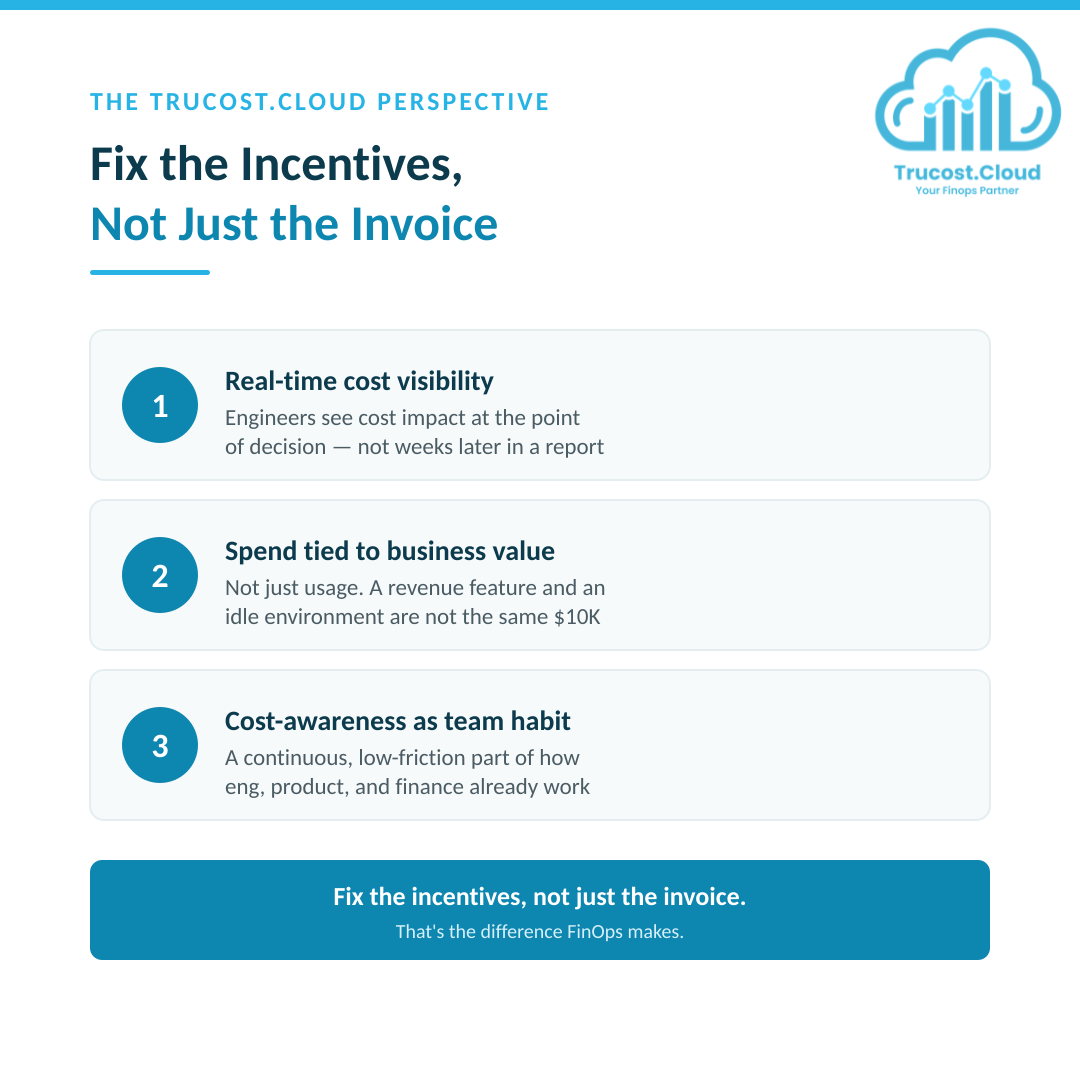
1. Cost Visibility at the Point of Decision
Rather than reviewing costs weeks later, engineers see estimated infrastructure costs while designing, provisioning, or modifying cloud resources.
That makes cost another engineering input—not just a finance metric.
2. Measuring Business Value, Not Just Cloud Spend
A $10,000 monthly workload isn’t inherently expensive.
If it powers a revenue-generating product serving thousands of customers, it may represent excellent value.
Meanwhile, a $2,000 idle staging environment provides no business return at all.
FinOps focuses on maximizing value—not simply minimizing spending.
3. Shared Ownership Across Teams
Successful cloud cost management isn’t owned exclusively by Finance.
Nor is it entirely Engineering’s responsibility.
Instead, engineering, finance, product, and leadership all share responsibility for ensuring cloud investments align with business outcomes.
That shared accountability transforms cloud cost management from periodic firefighting into a continuous operational discipline.
How Trucost.Cloud Helps
Many organizations already have dashboards.
They have AWS Cost Explorer.
They receive billing reports.
Yet they still struggle with unexpected cloud costs.
Why?
Because reports tell you what already happened.
They don’t influence the decisions being made today.
Trucost.Cloud is designed to bridge that gap.
Instead of showing cloud costs after deployment, it helps organizations bring cost visibility directly into the decision-making process.
With Trucost.Cloud, teams can:
- Understand the financial impact of infrastructure decisions before deployment.
- Connect cloud spending to business outcomes rather than raw infrastructure usage.
- Encourage shared cost ownership across engineering, finance, and leadership.
- Continuously identify optimization opportunities instead of relying on quarterly cleanups.
The goal isn’t simply to reduce cloud spend.
It’s to help organizations spend confidently, efficiently, and in alignment with business growth.
Frequently Asked Questions
Q1: Is FinOps just another name for cloud cost optimization?
No.
Cloud cost optimization focuses on reducing spending.
FinOps is the practice of maximizing business value from cloud investments by aligning cloud spending with organizational goals. While it often involves identifying opportunities to reduce unnecessary costs, its primary objective is to ensure that every dollar spent delivers measurable value. In many cases, this means increasing investment in cloud workloads that drive higher customer satisfaction, business growth, or strategic outcomes.
Q2: We already perform quarterly AWS bill reviews. Isn’t that enough?
Quarterly reviews identify waste after it has accumulated.
FinOps builds continuous cost visibility into everyday engineering workflows, helping teams prevent unnecessary spending before it reaches the monthly invoice.
Q3: Do we need a dedicated FinOps team?
Not necessarily.
Many organizations begin with shared cost dashboards, regular cloud cost reviews, tagging standards, and better visibility for engineering teams.
Dedicated FinOps teams often emerge as cloud environments become more complex.
Q4: Isn’t AWS Cost Explorer sufficient?
AWS Cost Explorer is an excellent reporting tool.
However, it requires users to actively investigate cloud costs after resources have already been deployed.
Effective FinOps surfaces relevant cost information proactively, within the workflows where engineering decisions are actually made.
Q5: What’s the best first step toward FinOps?
Start small.
Choose one product team or business unit.
Provide them with real-time cloud cost visibility, establish shared ownership of cloud spending, and review cloud costs regularly alongside engineering metrics.
Once the value becomes visible, expanding FinOps across the organization becomes much easier.
Final Thoughts
Every cloud-first organization eventually reaches a point where spreadsheets, dashboards, and quarterly billing reviews are no longer enough.
As cloud environments grow, so do the number of decisions that influence cost.
The organizations that manage cloud spending most effectively aren’t the ones that review invoices more often—they’re the ones that build cost awareness into every architectural decision.
An AWS bill review tells you where money was spent yesterday.
FinOps helps you make better decisions tomorrow.
Ready to Move Beyond AWS Bill Reviews?
If your engineering teams are making cloud architecture decisions without understanding their financial impact, it’s time to rethink how cloud cost management works.
Trucost.Cloud helps organizations bring real-time cost visibility into engineering workflows, connect cloud spending to business outcomes, and build a culture of shared cost ownership across engineering, finance, and leadership.
Schedule a personalized walkthrough to see how Trucost.Cloud helps engineering and finance teams make cloud cost decisions with confidence.