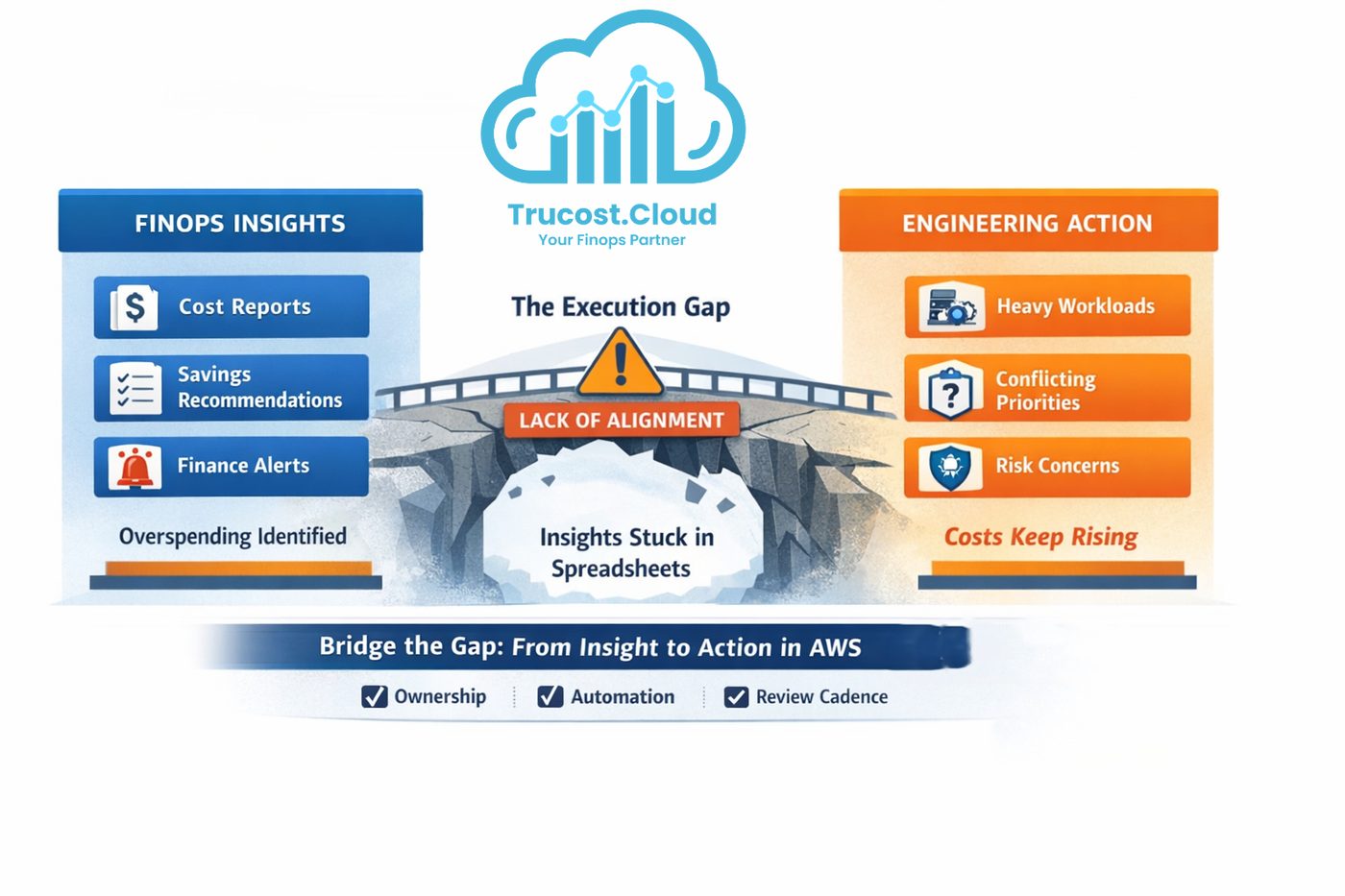
How to Close the Gap Between FinOps Insights and Engineering Actions in AWS
AWS FinOps fails due to poor execution, not visibility. A 6-step framework enables ownership, automation, and real engineering-driven cost savings.
Cloud cost visibility is no longer the problem. Most organizations using Amazon Web Services already have dashboards, alerts, anomaly detection, and forecasting tools in place.
The real challenge?
Turning FinOps insights into real engineering action.
However, engineering teams remain overloaded, misaligned, or unconvinced.
The result? Insights sit in spreadsheets. Costs continue to grow.
This blog explains how to close the gap between FinOps analysis and engineering execution in AWS — with a structured, scalable, and practical approach.
Executive Summary
Most AWS cost optimization programs fail not because of poor insights, but because of poor execution alignment. This guide outlines a 6-step operational framework to translate FinOps analysis into engineering action — creating accountability, automation, and predictable savings.
Understanding the Real Gap
Before solving it, we must understand it.
1. Visibility Without Accountability
Tools like AWS Cost Explorerprovide savings insights, rightsizing recommendations, and historical analysis. However, they do not assign ownership.
When no one owns a recommendation, nothing changes.
2. Technical Recommendations Without Context
Engineering teams often receive suggestions like:
Downsize instance
Delete idle resources
Purchase Savings Plans
Move to Graviton
Without business context (SLA impact, workload sensitivity, deployment timelines), these appear risky.
3. Finance vs Engineering Language Barrier
Finance talks in:
Budget variance
Forecast deviation
Unit economics
Engineering talks in:
Throughput
Autoscaling
Deployment risk
Architecture constraints
When these languages don’t translate, optimization stalls.
The 6-Step Framework to Close the Gap
Here’s a professional, field-tested framework that TruCost.Cloud uses to align FinOps with engineering.
Step 1: Establish Clear Cost Ownership
Without ownership, there is no action.
Implement:
Tag enforcement (application, team, environment, owner)
At Trucost.Cloud, we help teams convert these insights into actionable dashboards and scheduled executive summaries.
Automation ensures problems are identified early — not at month-end panic.
Step 5: Create a Monthly FinOps-Engineering Review Cadence
This is critical.
If RI/SP decisions happen only when costs spike:
Coverage becomes uneven
On-demand burn increases
Purchases become rushed
Instead, implement:
Monthly Cloud Review Agenda:
Last month actual vs forecast
Savings captured
Unimplemented recommendations
RI/SP coverage tracking
High-growth services
Risk review before optimization
Predictability beats panic.
Step 6: Build a FinOps Playbook for Engineering
Engineering teams act faster when guidelines are clear.
Create documentation covering:
Instance selection standards
Approved instance families
Storage lifecycle policies
Autoscaling configuration best practices
Non-prod shutdown policies
Purchase approval process for new services
For example:
Non-prod auto shutdown after business hours
gp3 instead of gp2 by default
Graviton-first policy for new workloads
Standardization reduces future waste.
Advanced Strategies for Mature Teams
If your organization is scaling rapidly, consider:
1. Unit Cost Tracking
Track:
Cost per customer
Cost per feature
This connects engineering decisions directly to product profitability.
2. Shift-Left FinOps
Integrate cost awareness into:
CI/CD pipelines
Architecture reviews
Infrastructure-as-Code approvals
Before deploying:
Estimate cost impact
Review tagging compliance
Validate scaling configuration
FinOps should happen before deployment — not after the bill arrives.
3. Incentivize Optimization
Recognize teams that:
Achieve highest savings
Maintain forecast accuracy
Improve cost efficiency per workload
Optimization becomes culture, not correction.
Common Mistakes to Avoid
🚫 Sending complex Excel sheets 🚫 Only reviewing cost at month end 🚫 Focusing only on EC2 while ignoring data transfer 🚫 Ignoring engineering risk concerns 🚫 Treating FinOps as a finance-only function
We don’t just provide reports. We enable execution.
Final Thoughts
The biggest AWS cost problem today is not visibility. It is execution alignment.
When:
Ownership is clear
Insights are converted into tickets
Reviews happen monthly
Automation reduces friction
Engineering understands business impact
FinOps becomes proactive instead of reactive.
And that’s where real cloud efficiency begins.
If your organization is struggling to turn AWS insights into measurable savings, Trucost.Cloud can help you bridge that gap — strategically and sustainably.
Frequently Asked Questions (FAQs)
What is the biggest challenge in AWS FinOps implementation?
The biggest challenge is not cost visibility but execution alignment. While tools like AWS Cost Explorer provide insights, organizations often lack structured ownership and engineering accountability to implement recommendations.
How can engineering teams take ownership of cloud costs?
Ownership can be improved by: Cost becomes actionable when tied to specific teams and KPIs.
Mandatory cost allocation tagging
Budget allocation per workload
Converting recommendations into tracked engineering tickets
Monthly FinOps review cadences
How often should AWS cost reviews happen?
Best practice is a monthly structured review, with weekly automated summaries. Monthly reviews should include forecast tracking, RI/SP coverage analysis, anomaly review, and implementation tracking.
What AWS tools help automate FinOps execution?
Key AWS-native tools include: However, tools alone are insufficient without operational processes.
AWS Budgets
AWS Cost Anomaly Detection
AWS Compute Optimizer
AWS Trusted Advisor
What is Shift-Left FinOps in AWS?
Shift-Left FinOps integrates cost awareness into CI/CD pipelines, infrastructure reviews, and architecture approvals before deployment — preventing cost inefficiencies before they reach production.
How do Savings Plans and Reserved Instances fit into FinOps strategy?
Savings Plans and Reserved Instances should be reviewed monthly for coverage and utilization. Reactive purchases during cost spikes often lead to suboptimal coverage. A structured cadence improves predictability.
What metrics connect engineering decisions to profitability?
Advanced FinOps teams track: These metrics align cloud infrastructure with product economics.
Cost per customer
Cost per feature
Gross margin per workload
Why do FinOps initiatives fail in many organizations?
Common reasons include: FinOps must operate as a cross-functional model, not a finance-only activity.
No clear ownership
Poor tagging discipline
Finance-engineering misalignment
Over-reliance on dashboards without execution systems
Lack of leadership sponsorship
How can Trucost.Cloud help improve AWS cost execution?
Trucost.Cloud helps organizations: The focus is not just visibility — but measurable execution.
Convert cost insights into engineering-ready actions